
Engineers: Requirements Decomposition to 2–3 Levels with AI

Requirements decomposition is the process of splitting a parent requirement into smaller, verifiable child requirements that a single team can implement and test. The rule of thumb: stop decomposing once a requirement can be built by one owner and verified with one clear method. Keep going and you’re drifting into design; stop too early and you leave ambiguity, untestable language, or conflicting stakeholder intent baked into the system.
TL;DR:
- Decomposition should stop once a requirement can be owned and verified by a single team, typically after two to three levels of breakdown.
- Properly decomposed requirements enable clear verification methods, help identify stakeholder conflicts early, and provide reliable traceability for audits.
- Different decomposition patterns—functional, data, component, and quality—must match the system’s nature to produce useful interfaces and avoid unnecessary design specifications.
- Architectural context and stakeholder input are essential before decomposing requirements to ensure clarity, alignment, and correct allocation.
- AI tools like Segua.ai can assist with drafting, contradictions, and trace links but require human judgment for allocation, architecture, and validation.
Table of Contents
- What Is Requirements Decomposition, and How Does It Differ From Analysis and Design?
- Why Decomposition Matters for Verification, Cost, and Conflict Resolution
- Decomposition Patterns: Functional, Data, Component, and Quality Breakdowns
- A Step-by-Step Workflow for Decomposing Requirements
- Building Allocation Records and Trace Matrices That Actually Hold Up
- When to Stop Decomposing: Practical Level-of-Detail Rules
- Common Pitfalls in Requirements Decomposition and How to Fix Them
- How AI and Tools Support Requirements Decomposition
- How Segua.ai Fits Into a Decomposition Workflow
- Why Stakeholder Communication Shapes Decomposition Quality
- Requirements Decomposition in Agile and Other Development Methods
- How Decomposition Reduces Project Risk
- Real-World Examples of Effective Decomposition
- Model-Driven vs. Document-Driven Decomposition
- Try Segua.ai for Faster, Traceable Requirement Decomposition
- Why Most Teams Get the Stopping Point Wrong
- Sources
- FAQ
What Is Requirements Decomposition, and How Does It Differ From Analysis and Design?
Requirements decomposition sits in a specific spot in the systems engineering lifecycle, and mixing it up with the steps around it causes more downstream confusion than almost any other terminology slip in the discipline.
Requirements analysis comes first. This is where a business analyst or systems engineer structures raw stakeholder input, models it, checks it for consistency, and defines the requirements architecture. The IIBA’s BABOK framework treats this as organizing and validating what stakeholders actually need, before anyone touches allocation.
Decomposition happens next, or alongside. It takes those analyzed, validated needs and breaks them into detailed, allocatable pieces. A parent requirement like “the vehicle shall detect obstacles” decomposes into child requirements covering sensor range, processing latency, and alert thresholds, each one traceable back to its parent.
Design comes after or beside decomposition, answering how the system implements what decomposition defined what for.
A few terms get used loosely, so it helps to pin them down:
- Decomposed requirements break a parent into functional or structural pieces without changing scope.
- Derived requirements emerge from design or architecture decisions, not directly from stakeholder input (a redundancy requirement derived from a reliability target, for instance).
- Allocated requirements assign a decomposed or derived requirement to a specific subsystem, component, or team.
This chain feeds directly into the V-model: every requirement decomposed on the left side of the V needs a corresponding verification activity on the right side. Skip the decomposition step or do it sloppily, and you end up with verification activities that don’t map cleanly to anything testable.
Why Decomposition Matters for Verification, Cost, and Conflict Resolution
Skipping or rushing decomposition doesn’t just create messy documentation. It creates expensive rework.
NASA’s software requirements guidance (SWE-051) is blunt about this: requirements must be confirmed clear, feasible, verifiable, and maintainable, and failing to complete that decomposition before design work starts raises the risk and cost of rework later. A requirement that looked fine at the system level but turns out unverifiable at the component level doesn’t just cost a rewrite. It costs a redesign, a re-test, and often a schedule slip that ripples through every dependent subsystem.
The cost curve is not linear. A requirement error caught during decomposition costs a conversation and a document edit. The same error caught during integration testing costs a teardown, a fix, and a re-verification cycle across every system it touches.
Decomposition also does something less obvious: it forces conflicts into the open early. When you break a broad stakeholder need into concrete, allocatable child requirements, contradictions between what two stakeholders assumed become visible immediately, not six months into implementation. The IIBA’s model treats this conflict surfacing as one of the primary values of the analysis-to-decomposition handoff. It’s also where earlier value and cost estimation becomes possible, since you can’t price out a vague requirement, only a decomposed one.
Traceability is the third payoff. Every parent-child link you establish during decomposition becomes an audit trail later: when a regulator, customer, or new team member asks “why does this component behave this way,” the trace matrix answers it without a meeting.
Decomposition Patterns: Functional, Data, Component, and Quality Breakdowns
Not every requirement decomposes the same way, and picking the wrong pattern for the situation creates interfaces that don’t match how the system actually needs to be built or tested.
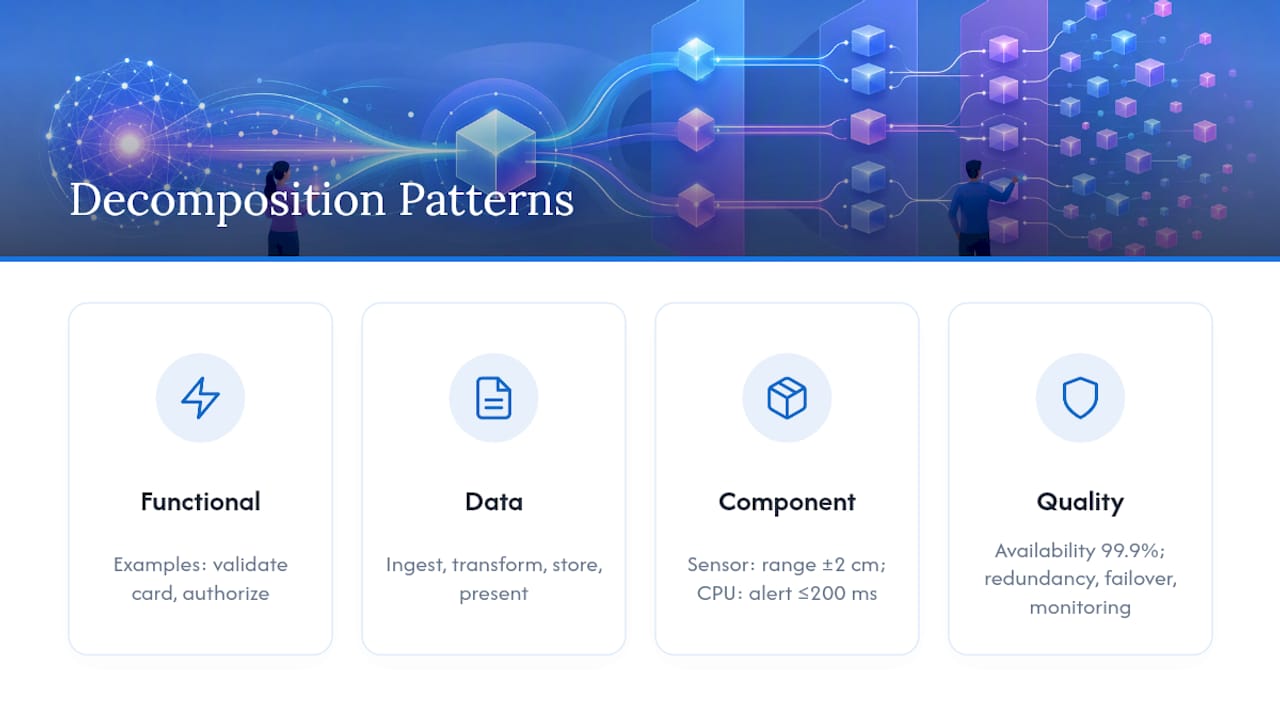
Functional decomposition breaks a requirement by what the system does. “The system shall process payment transactions” splits into sub-functions: validate card, check fraud rules, authorize amount, log transaction. This is the most common pattern for early-stage system requirements definition, because it maps naturally to use case analysis and lets you sequence flows before anyone commits to a specific architecture.
Data decomposition breaks requirements by the information flowing through the system rather than the actions performed on it. A reporting requirement might decompose into requirements for data ingestion, transformation, storage, and presentation, each with its own verification method.
Component (or physical) decomposition allocates requirements to actual hardware or software elements once the architecture exists. This is where “the system shall detect obstacles” becomes “the sensor module shall report range within 2 centimeters” and “the processing unit shall generate an alert within 200 milliseconds.” Physical decomposition only works once you’ve settled the architecture, which is why NASA’s guidance insists on establishing the system architecture model before functional analysis starts.
Quality (or logical) decomposition handles non-functional requirements, things like reliability, safety, and performance, that cut across multiple components rather than living in one. A logical decomposition of “the system shall be available 99.9% of the time” touches redundancy design, failover logic, and monitoring, spread across several physical components.
Choosing between reference grouping (organizing by shared attribute, like all requirements touching a data field) and ownership composition (organizing by the team or component that owns the work) depends on how your teams are structured. Reference grouping helps with impact analysis across a system. Ownership composition helps with accountability and sprint planning. Most mature programs use both simultaneously, tagging requirements one way for traceability and another way for team assignment.
The pattern you choose shapes your interfaces. Functional decomposition tends to produce clean input/output interface definitions. Component decomposition tends to expose interface gaps between subsystems that nobody had modeled yet, which is often a good thing to discover before integration, not during it.
A Step-by-Step Workflow for Decomposing Requirements
Here’s a workflow you can apply on a live project this week, whether you’re running a defense systems program or a mid-size product team.
Before you start, gather these inputs:
- Baselined parent requirements (not draft, not “mostly agreed”)
- A concept of operations (ConOps) or equivalent scenario description
- Documented stakeholder decisions, especially any trade-off calls already made
-
Establish the architecture first. NASA’s logical decomposition guidance makes this step zero, not step three. Define your system architecture or product breakdown structure before you start splitting requirements, because allocation without an architecture produces child requirements with nowhere real to attach.
-
Perform functional analysis. List the sub-functions the parent requirement implies, and sequence them as flows. This is where you catch a missing function before it becomes a missing requirement.
-
Draft child requirements. Write each one with a unique ID, a clear rationale linking it back to the parent, and language specific enough to verify. Avoid copying parent language downward with only cosmetic changes; that’s decomposition in name only.
-
Allocate to owners. Every child requirement needs exactly one owning team or component. If you find yourself splitting ownership across two teams for one requirement, that’s a signal you haven’t decomposed far enough.
-
Define the verification method for each child. Test, analysis, inspection, or demonstration. Assign it now, not during test planning, so gaps surface while they’re still cheap to fix.
-
Check traceability both directions. Every child should trace up to a parent, and every parent should show complete coverage across its children. Gaps in either direction mean either a missing requirement or an orphaned one.
-
Baseline, then maintain the chain. Once approved, changes to any requirement in the chain trigger a re-check of everything linked to it. NASA’s technical requirements definition guidance treats this as inherently iterative: architecture changes force re-decomposition, not a one-time patch.
Pro Tip: Assign verification methods during decomposition, not during test planning. Teams that wait until test planning to ask “how do we verify this?” routinely discover requirements that were never actually testable in the first place, and by then, redesigning them costs far more than a five-minute conversation would have.
Building Allocation Records and Trace Matrices That Actually Hold Up
An allocation rationale is the document (or database record) that justifies why a child requirement exists and where it lives. A solid one includes the parent requirement ID, the full list of child IDs, a short rationale for the split, a coverage statement confirming the children fully satisfy the parent, and the verification method assigned to each child. Skip the coverage statement and you’ll find gaps only during an audit, which is the worst possible time to find them.
A trace matrix is how you check this at scale. It’s a table (or, more realistically, a live database view in a requirements management tool) linking every parent to its children and every child to its verification activity. Run it both directions: forward from parent to children catches incomplete decomposition, backward from children to parents catches orphaned requirements that snuck in without proper heritage.
Tool-based checks matter here because manual trace matrix review doesn’t scale past a few hundred requirements. Modern requirements platforms can flag “suspect links”: relationships where a parent or child changed after the link was established, meaning the trace may no longer be valid. Prioritize suspect links by how many downstream requirements depend on them, not by however they happen to sort alphabetically.
- Suspect links touching safety or compliance requirements get reviewed first, always.
- Suspect links with a single child and a simple text change can usually wait for the next batch review.
- Suspect links spanning multiple subsystems need an architecture-level conversation, not just a document edit.
| Verification method | Example child requirement | Pass criteria |
|---|---|---|
| Test | Sensor reports range accuracy | Measured error within 2 centimeters |
| Analysis | System meets 99.9% availability | Reliability model output at or above 99.9% |
| Inspection | Wiring meets gauge specification | Physical inspection confirms gauge match |
| Demonstration | User completes checkout in under 3 steps | Live walkthrough completes in 3 or fewer steps |
When to Stop Decomposing: Practical Level-of-Detail Rules
The most common decomposition mistake isn’t doing it wrong. It’s not knowing when to stop.
- Stop when a single owner or team can implement and verify it. If a requirement still requires coordination across two teams to fully implement, it needs one more level of breakdown.
- Cap formal decomposition at roughly two to three levels (system, subsystem, component) for most programs. Beyond that, you’re usually writing design specifications and calling them requirements.
- Don’t decompose constraints or uniformly applied requirements. A regulatory constraint that applies system-wide, like “the system shall comply with [applicable safety standard],” doesn’t need ten child requirements. It needs one, applied consistently.
- Use a readability heuristic. If a requirement statement runs past eight to ten sentences or mixes more than one concern (say, a performance target and a safety constraint in the same line), that’s a signal to split it, even if you haven’t hit a formal decomposition trigger yet.
The NASA and NoMagic documentation on this both point the same direction: decomposition is recursive and iterative, but recursive doesn’t mean infinite. Once a requirement is verifiable, allocatable, and owned by one team, further breakdown adds documentation overhead without adding clarity.
Common Pitfalls in Requirements Decomposition and How to Fix Them
Most decomposition failures trace back to a handful of repeatable patterns.
Passive voice hides the actor. “Data shall be validated” doesn’t say who validates it or under what condition. Rewrite as “the input module shall validate data fields against the schema before submission.” Now it’s assignable and testable.
Compound conditions bury multiple requirements in one sentence. “The system shall log the event and notify the operator if the threshold is exceeded” is two requirements wearing one ID. Split them: one for logging, one for notification, each independently verifiable.
A quick checklist for whether a requirement is genuinely decomposed and ready to baseline:
- Does it name a specific actor (system, module, team)?
- Does it specify a concrete action?
- Does it state the condition under which the action applies?
- Can you write a pass/fail test for it without further clarification?
If any answer is no, it’s not done, no matter how confident the draft looks.
Conflicting requirements surface constantly during decomposition, and the fix isn’t debate, it’s modeling. Put competing requirements side by side in a decision log, note which stakeholder owns each, and route the conflict to whoever has authority over the trade-off. Document the resolution in the same log so nobody re-litigates it three sprints later.
Pro Tip: Keep a running decision log from day one of decomposition, not just when conflicts get loud. Half the value of the log is having a record of decisions nobody remembers making six months later.
How AI and Tools Support Requirements Decomposition
Modern requirements platforms have gotten genuinely useful at the mechanical parts of decomposition, and genuinely bad at the judgment parts, which is exactly the split you’d expect and exactly the split you should plan around.
What AI does well: ambiguity detection (flagging passive voice, vague qualifiers like “fast” or “user-friendly,” and missing conditions), pattern checks against structured formats like EARS (Easy Approach to Requirements Syntax), suggesting candidate child requirements based on how similar parents have been decomposed before, and automatically generating trace links between parents and children. Tools can also flag “suspect” links when a linked requirement changes, and some can generate candidate test cases directly from well-formed child requirements, feeding straight into verification planning.
What AI doesn’t do well: allocation judgment (deciding which team owns a requirement is an organizational call, not a text-parsing one), architecture decisions, and interface management between subsystems, all of which require context AI tools don’t have and shouldn’t be trusted to infer.
A quick checklist for evaluating any decomposition tool before committing to it:
- Does it maintain forward and backward traceability automatically?
- Can it export to formats your team actually uses (Word, PDF, Jira, CSV)?
- Does it support a human review workflow before anything gets baselined, rather than auto-approving suggestions?
- Does it flag contradictions and unanswered questions, not just formatting issues?
AI-supported decomposition tools can meaningfully cut the manual drafting load, but engineer judgment on allocation and architecture stays essential no matter how good the suggestion engine gets.
How Segua.ai Fits Into a Decomposition Workflow
Requirements decomposition lives or dies on whether the paper trail behind it is trustworthy, and that’s the part most teams neglect because it’s tedious, not because it’s hard.
Segua.ai generates requirement specifications directly from meeting recordings or uploaded content, which matters because a huge share of decomposition inputs (stakeholder decisions, scope clarifications, trade-off calls) get made verbally in a meeting and then forgotten or misremembered by the time someone drafts the child requirements. The platform also tracks contradictions and unanswered questions across a project, which directly improves decomposition quality: a contradiction caught before you draft child requirements is a five-minute fix, and one caught during integration testing is a redesign.
If you’re evaluating this for your own workflow, pilot it on a single feature-level meeting first. Generate the child requirements, then have a systems engineer or business analyst validate them against the actual discussion before anything gets baselined. Treat the AI output as a strong first draft, not a final one, the same discipline you’d apply to any other automated suggestion engine in this space.
Why Stakeholder Communication Shapes Decomposition Quality
Decomposition is not a solitary drafting exercise. The quality of your child requirements depends directly on how well you’ve communicated with the stakeholders who own the parent requirement’s intent.
The most common decomposition failure isn’t a missing test case. It’s a systems engineer decomposing a requirement based on their own assumption of what the stakeholder meant, without confirming it. A parent requirement like “the system shall be user-friendly” means completely different things to a compliance officer, a product manager, and an end customer, and decomposing it without pulling those three people into the same conversation guarantees you’ll satisfy one interpretation while missing the other two.
Structured elicitation sessions, walkthroughs of draft child requirements with the original stakeholder, and shared decision logs all reduce this risk. The goal isn’t consensus on every line item; it’s making sure the person who owns the parent requirement’s intent has actually seen how it got split apart, before that split becomes a baseline nobody can cheaply undo.
Cross-functional review matters just as much. A child requirement allocated to a hardware team needs a sanity check from whoever owns the adjacent software interface, because decomposition decisions made in isolation are exactly where interface mismatches get born. Building a short review cycle into your decomposition workflow, even fifteen minutes with the affected teams, catches these mismatches while they’re still a conversation instead of a change request.
Requirements Decomposition in Agile and Other Development Methods
Decomposition doesn’t disappear in agile environments. It just happens at a different cadence and with lighter documentation.
In a traditional waterfall or V-model program, decomposition happens largely upfront, with a full baseline established before design starts. In agile environments, decomposition happens continuously: an epic decomposes into user stories, and a user story often decomposes further into acceptance criteria, which function as lightweight child requirements even when nobody calls them that. The underlying discipline is identical, verifiable, allocatable, single-owner pieces, even though the vocabulary and the ceremony around it differ.
The risk in agile contexts is that speed encourages skipping the rationale. A user story split into three sub-stories during sprint planning, with no record of why, loses traceability the moment the sprint ends and the context leaves people’s memory. Teams that maintain lightweight traceability, even a simple link from acceptance criteria back to the epic, keep the audit trail intact without slowing sprints down.
Hybrid programs, common in regulated industries doing agile development under a V-model umbrella, tend to do system-level decomposition formally and upfront, then let story-level decomposition happen iteratively within each subsystem’s backlog. This gives you formal traceability where regulators or safety cases require it, and speed where the work is genuinely exploratory.
How Decomposition Reduces Project Risk
Poor decomposition is one of the most common root causes of budget and schedule risk in systems programs, and it’s often invisible until integration testing exposes it.
An under-decomposed requirement, one still too vague to verify, doesn’t fail during requirements review. It fails during integration, when two teams discover they built to different interpretations of the same parent requirement. That kind of failure is expensive precisely because it surfaces late, after both teams have already committed engineering hours to their respective interpretations.
Well-executed decomposition converts this unknown risk into a known, manageable one. Each child requirement with a defined verification method gives you an early, cheap checkpoint instead of a late, expensive one. Trace matrices let program managers run impact analysis before approving a change, instead of discovering the ripple effects after the change has already broken three other subsystems.
Decomposition also supports better estimation. A vague parent requirement resists cost and schedule estimation because nobody knows what “done” looks like. A properly decomposed set of child requirements, each allocatable and verifiable, gives estimators something concrete to size, which is a large part of why the IIBA frames decomposition as enabling earlier value and cost estimation, not just clearer documentation.
Real-World Examples of Effective Decomposition
Consider a parent requirement in an automotive context: “the vehicle shall provide collision avoidance.” Decomposed poorly, this stays a single line that nobody can verify or build against. Decomposed well, it splits into a sensing requirement (detection range, update rate), a processing requirement (latency threshold for hazard assessment), and an actuation requirement (braking response time), each allocated to a different subsystem team, each with its own test method.
In a software context, a parent requirement like “the platform shall support secure user authentication” decomposes into password policy enforcement, multi-factor authentication triggers, session timeout behavior, and audit logging of failed attempts. Each child gets its own owner (often different teams within the same product organization) and its own verification approach, some via automated test suites, some via security audit.
The common thread across both examples: decomposition succeeded because each child requirement mapped to exactly one verification method and exactly one owning team. Neither example required more than three levels of breakdown to get there, which lines up with the practical ceiling most mature programs settle on.
Model-Driven vs. Document-Driven Decomposition
Safety-critical, high-interface systems (aerospace, medical devices, automotive) generally benefit from model-driven decomposition using tools like SysML, where requirement diagrams and containment trees make interface dependencies visible before they become integration surprises. Document-driven decomposition, plain requirement statements in a spreadsheet or requirements management tool, works fine for smaller agile teams with fewer subsystem interfaces and lower certification burden.
Most programs land somewhere in between: model-driven decomposition for the system and subsystem levels where interfaces matter most, document-driven for story-level breakdown within a single team’s backlog. If you’re moving from documents to models, start with your highest-risk interfaces first, not a full system migration, since that’s where model-driven tooling pays for itself fastest.
Try Segua.ai for Faster, Traceable Requirement Decomposition
Most teams doing requirements decomposition today are still copying meeting notes into a document, manually drafting child requirements, and hoping nobody forgot a stakeholder decision from three weeks ago. Segua.ai automates the meeting-to-requirements step directly: upload a recording or transcript, and it drafts requirement specifications, flags contradictions, and surfaces unanswered questions that would otherwise sit buried until someone stumbles on them during integration.
A practical way to test this is to run one feature-level meeting through Segua.ai, review the generated child requirements against what was actually discussed, and check the traceability links it builds automatically. That single pilot tells you whether it fits your workflow before you commit further. The Pro plan is available via a subscription plan, with additional meeting hours billed separately, and Enterprise pricing is available on request for larger programs. You can also see how the platform handles common project and requirements use cases before deciding.
Start a free trial and generate your first set of meeting-based requirements in under a minute.
Why Most Teams Get the Stopping Point Wrong
The technical mechanics of decomposition are well documented. Where most teams actually go wrong isn’t the workflow, it’s judgment about when to stop, and I think that gets underexplained in most guidance on this topic.
There’s a real bias toward over-decomposition in engineering cultures that reward thoroughness. Teams keep splitting requirements past the point of usefulness because stopping feels like leaving work undone, when in reality a fourth or fifth level of breakdown usually means you’ve quietly started writing design specifications and mislabeling them as requirements. That’s not rigor. That’s scope creep wearing a systems engineering costume.

The opposite failure, under-decomposition, gets less attention but causes more expensive damage. It happens when teams are under schedule pressure and treat decomposition as a formality to clear rather than a risk-reduction step to do properly. A requirement that “sounds decomposed” because it has a child ID attached, but still isn’t independently verifiable, is worse than no decomposition at all, because it creates false confidence that the coverage gap has already been closed.
The tools available now, AI-assisted child suggestion, automated trace links, suspect flagging, genuinely help with the mechanical half of this problem. They do nothing for the judgment half. Deciding whether a child requirement is truly single-owner and truly verifiable still requires a human who understands the architecture and the stakeholders, and no amount of automation changes that. Teams that treat AI-generated child requirements as a draft to validate, rather than an answer to accept, get the real benefit. Teams that skip the validation step just move the same old under-decomposition problem downstream, faster.
Sources
For deeper reading beyond this guide, NASA’s systems engineering handbook covers logical decomposition and technical requirements definition in detail, including architecture-first sequencing and baselining rules. The IIBA’s BABOK guide covers requirements analysis and design definition from a business analysis lens. For model-based practices, NoMagic’s documentation covers containment trees and requirement diagrams in SysML tooling.
- Requirements decomposition and how AI supports it — Jama Software
- 4.3 Logical decomposition — NASA
- SWE-051 Software requirements analysis — NASA
- Requirements analysis and design definition — IIBA / BABOK
FAQ
What Conditions Are Required Before You Can Decompose a Requirement?
A requirement needs to be baselined, clear, and validated with stakeholders before decomposition starts, and the system architecture or product breakdown structure needs to exist first, since decomposition without an established architecture produces child requirements with nowhere firm to attach.
What Are the Main Steps in Requirements Analysis?
Common steps include eliciting stakeholder needs, structuring and modeling requirements, verifying and validating them, defining the requirements architecture, decomposing and allocating requirements, assigning verification methods, and baselining the result, following the general sequence the IIBA’s BABOK framework describes.
What Are the Four Main Types of Requirements Decomposition?
Functional decomposition (splitting by what the system does), data decomposition (splitting by information flow), component or physical decomposition (allocating to hardware or software elements), and quality or logical decomposition (handling cross-cutting non-functional requirements like reliability and safety) cover the main patterns teams use.
What Are the Stages of Decomposition in Order?
A practical sequence runs: establish the architecture, perform functional analysis, draft and allocate child requirements, assign verification methods, confirm traceability, and baseline the result, with re-decomposition triggered any time the architecture changes.
How Far Should You Decompose a Requirement?
Stop once a single team or component owner can implement and verify it, typically within two to three levels of breakdown; going further usually means you’ve started writing design specifications instead of requirements.
Can Segua.ai Help With Requirements Decomposition Directly?
Segua.ai generates requirement specifications from meeting recordings or uploaded content and tracks contradictions and open questions across a project, which supports the drafting and quality-check side of decomposition, though allocation and architecture decisions still need engineer review before baselining.